
CPS tears into Mahama’s 24-hour economy, questions Big Push job claims
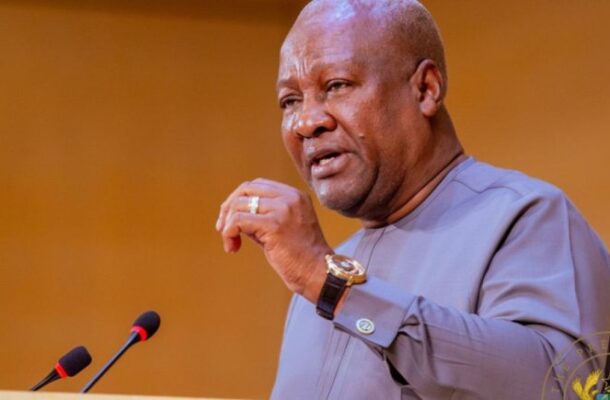
The Mahama administration’s flagship 24-Hour Economy and Accelerated Export Development Programme (24H+) is facing fresh scrutiny after the Centre for Policy Studies (CPS) questioned the government’s claims of job creation, arguing that six months into implementation there is little verifiable evidence that the much-publicised initiative has translated into the hundreds of thousands of jobs promised to Ghanaians.
In a comprehensive review of the 2026 Budget Statement and Mid-Year Fiscal Policy, the independent policy think tank said while government has made progress in establishing institutions and mobilising investment for the programme, the actual employment outcomes remain largely unverified, with many of the flagship projects still at preparatory stages.
The report, prepared by economists Dr. Adu Owusu Sarkodie, Dr. Prince Adjei, Dr. Jacob Novignon and Miss Stephanie Anokyewa Tawiah, argues that the government’s employment narrative is running ahead of the available evidence.
24-Hour Economy Was Mahama’s Biggest Campaign Promise
The 24-Hour Economy was one of President John Dramani Mahama’s signature promises during the 2024 election campaign.
The National Democratic Congress (NDC) presented the policy as a transformative economic programme designed to keep businesses, industries and public institutions operating around the clock through multiple work shifts. The initiative was promoted as a strategy to increase production, stimulate exports, attract investment and create millions of sustainable jobs over the next decade.
Following the NDC’s electoral victory, Parliament passed the 24-Hour Economy Authority Act, 2026, paving the way for implementation of the programme.
Government has repeatedly described the policy as the centrepiece of Ghana’s economic transformation agenda, linking it to industrialisation, export expansion and youth employment.
However, the CPS review suggests that the reality on the ground is yet to match the ambitious promises.
Shift Work Already Existed Before 24H+
One of the report’s strongest criticisms is that many of the businesses government now cites as embracing the 24-Hour Economy were already operating multiple shifts long before the policy was launched.
According to the review, the Mid-Year Budget reported that 268 fuel stations, 11 bulk oil depots, two oil refineries, 33 manufacturing companies and 12 public institutions had adopted multi-shift operations.
But the CPS questioned whether these examples genuinely demonstrate the success of the new policy.
“The minister mentions that implementation of the 24 H+ is gathering momentum… However, the question is—did you need a government programme to implement this? It was already happening before the 2024 elections,” the report noted.
The think tank argues that the figures merely show participation in shift work and not proof that new employment has been created.
Jobs Yet To Be Verified
While government has projected that the programme could create more than five million jobs by 2034, the CPS says there is currently no publicly available payroll data or employment records to verify the actual number of jobs generated.
According to the report, three garment factories expected to create approximately 27,000 direct jobs remain at the investor mobilisation stage.
Government has engaged transaction advisers to attract investors, but construction, factory commissioning, production and worker recruitment have not yet been reported.
Similarly, seven planned agro-processing factories expected to employ hundreds of workers have not been accompanied by detailed implementation or employment updates.
The report therefore concludes that these employment figures should still be regarded as projections rather than verified achievements.
Big Push Also Comes Under Spotlight
The CPS also turned its attention to government’s flagship Big Push Infrastructure Programme, another major pillar of the Mahama administration’s economic agenda.
The programme, launched to accelerate road, bridge and infrastructure construction nationwide, was allocated GH¢30 billion, with government estimating that road contracts worth GH¢63 billion could generate nearly 490,000 jobs.
Although the report acknowledges that implementation has begun, it says the employment figures remain largely unsubstantiated.
According to the review, work has commenced on 87 projects, including 74 trunk roads and bridges, 10 urban roads and three feeder roads.
Of these, 13 projects have reached at least 50 percent completion, while another 15 have exceeded 25 percent completion.
Government has also paid approximately GH¢6.5 billion towards the programme during the first half of 2026.
Despite these developments, CPS argues that there is no published national workforce data showing how many workers have actually been employed on the projects.
“The Budget’s estimate of 490,000 jobs remains unverified because the Mid-Year Review does not disclose payroll employment, worker-months or project-level employment records,” the report stated.
Budget Execution Becoming A Major Concern
Beyond questioning employment claims, the think tank warned that the government’s overall budget implementation continues to face significant challenges.
The review found that capital expenditure remains substantially below target, slowing infrastructure delivery across several sectors.
It noted that many Ministries, Departments and Agencies have struggled to execute planned projects because actual expenditure has consistently fallen short of approved budget allocations.
According to CPS, this has resulted in delayed infrastructure development and under-delivery of several government programmes despite improved macroeconomic indicators.

