Minority takes on Sammy Gyamfi over GoldBod GHC22bn mess
The Minority in Parliament has intensified its criticism of the government’s handling of the Ghana Gold Board (GoldBod), accusing its Chief Executive Officer, Sammy Gyamfi, of avoiding the substantive questions surrounding the financial over GHC22 billion losses associated with the Domestic Gold Purchase Programme.
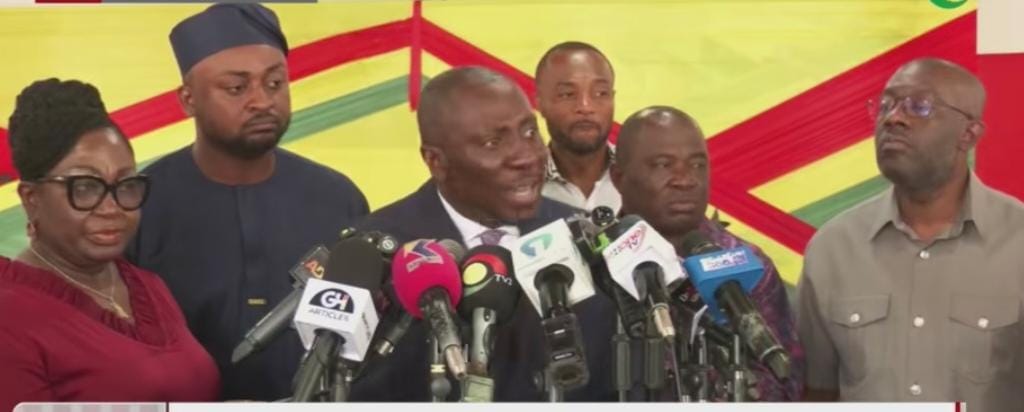
Addressing a press conference in Parliament House on Tuesday, Minority Leader Alexander Afenyo-Markin said the controversy was no longer simply about whether GoldBod itself recorded an accounting loss, but about the broader financial consequences of the gold trading arrangement and the burden ultimately carried by the Bank of Ghana and, by extension, the Ghanaian taxpayer.
According to the Minority’s press statement, the latest International Monetary Fund (IMF) Sixth and Final Review of Ghana’s Extended Credit Facility programme, completed on July 10, 2026, reported that the Domestic Gold Purchase Programme generated losses equivalent to US$1.7 billion, or approximately GH¢22 billion, in 2025 alone. The Minority said the figure represents about 1.5 per cent of Ghana’s Gross Domestic Product.
Afenyo-Markin stressed that the Minority was not claiming that GoldBod had necessarily reported GH¢22 billion as a loss on its own financial statements. Rather, he said the critical issue was that the gold trading arrangement operated through GoldBod generated substantial losses which were ultimately absorbed by the Bank of Ghana.
The Minority pointed to the financing structure under which GoldBod acted as a buying agent for the central bank. Under that arrangement, GoldBod purchased and aggregated gold with funding provided by the Bank of Ghana, while the central bank incurred the costs associated with the gold aggregation arrangement. GoldBod, meanwhile, occupied a central operational position in the buying, weighing, grading, assaying, valuing and exporting of gold.
It is this separation between operational responsibility and the location where the financial losses were recorded that has become the central point of the Minority’s attack.
The Minority argued that the fact that GoldBod may not have recorded the entire loss on its own balance sheet does not eliminate the economic loss suffered by the state. Afenyo-Markin maintained that an accounting arrangement cannot be used to shield public officials and institutions from questions about how public resources were deployed.
The press statement recalled that concerns over the gold programme had already emerged in an earlier IMF review. The IMF’s Fifth Review had identified an estimated US$214 million quasi-fiscal loss through September 2025 and attributed the losses to trading activities, fees and exchange-rate movements. It also called for stronger transparency, governance and risk management around the GoldBod-linked channel of the Domestic Gold Purchase Programme.
The Minority said subsequent explanations that GoldBod itself had not made a loss failed to address the larger question of how much Ghana had lost through the transactions.
According to the Minority, the IMF had subsequently provided a fuller picture, identifying losses arising from service and assay fees paid to GoldBod, discounts on gold sold to off-takers and, significantly, exchange-rate losses resulting from the difference between the forex bureau rate used to purchase gold and the cedi reference rate used by the Bank of Ghana for accounting purposes.
Afenyo-Markin therefore challenged Sammy Gyamfi and GoldBod to provide detailed answers on the prices paid for gold, how those prices were determined, whether premiums were paid to secure supplies, how international off-takers were selected and the discounts at which doré gold was sold.
He also demanded information on the amount GoldBod earned in service and assay charges from transactions financed by the Bank of Ghana, the commercial risks GoldBod itself carried, the risks transferred to the central bank and the internal controls that were supposedly in place to protect the institution providing the financing.
The Minority’s argument is that GoldBod cannot simply rely on its own reported financial position to dismiss questions about transactions undertaken with Bank of Ghana funding.
Afenyo-Markin described the arrangement as one requiring particular scrutiny because one institution could earn fees from transactions while another institution bore the principal financial risk. He argued that such a structure could create what governance professionals describe as a moral-hazard problem, particularly where increasing transaction volumes could increase an agent’s revenues even when the broader programme was generating losses for the financier.
GoldBod announced on August 11, 2026, that it had ended its role as a buying agent for the Bank of Ghana and had ceased receiving BoG funds for gold purchases since March 2026. The new arrangement, according to the statement, involves GoldBod mobilising financing directly from commercial banks and off-takers.
The Minority also highlighted GoldBod’s acknowledgment that it had asked the Bank of Ghana to discontinue its previous foreign-exchange intermediation role because of recurring costs associated with the arrangement. The IMF, meanwhile, has called for the permanent discontinuation of quasi-fiscal activities by the central bank and identified the transfer of Domestic Gold Purchase Programme activities to GoldBod as part of efforts to eliminate those risks.
For the Minority, the change in the financing model raises questions about why an arrangement previously defended by the government and its officials had to be substantially restructured.
Afenyo-Markin consequently challenged the government and GoldBod to explain why the Bank of Ghana stopped financing the purchases, why the IMF insisted on moving the activity away from the central bank and why GoldBod shifted towards commercial-bank and off-taker financing.
The Minority, however, sought to distance its criticism from opposition to GoldBod as an institution or to Ghana’s objective of accumulating gold reserves.
According to the press statement, the Minority believes gold purchases can play an important role in strengthening Ghana’s external reserves and supporting macroeconomic stability. It argued that the real issue is not whether Ghana should purchase gold but the cost of doing so, the governance structure, whose money is being used, who carries the risk and what mechanisms exist to ensure accountability.
The Minority also used the controversy to revive its argument that the current administration adopted an idea originally advanced by the NPP ahead of the 2024 general election.
The statement said the NDC’s manifesto contained a pledge to establish a Ghana Gold Board to regulate and restructure small-scale mining, while then-NPP presidential candidate Dr Mahamudu Bawumia had presented a broader proposal in his August 18, 2024 manifesto launch involving consolidation of gold purchasing arrangements, foreign-exchange reserve accumulation and macroeconomic stability. The Minority said Bawumia’s proposal also stressed that the programme should remain commercially sound and should not become a loss-making venture.
Against that background, Afenyo-Markin argued that the NPP could not reasonably oppose gold reserve accumulation or the concept of GoldBod simply because the policy was now being implemented by the NDC government.
Instead, he said the Minority’s concern was the manner in which the programme had been executed and the financial risks created for the state.
The Minority further invoked Article 257(6) of the 1992 Constitution, arguing that Ghana’s mineral resources are vested in the President on behalf of and in trust for the people of Ghana. It said the government therefore has a responsibility to ensure that the country’s gold resources and the public finances associated with their management are protected.
The controversy has also moved beyond public exchanges into Parliament.
Afenyo-Markin disclosed that the Minority intends to return to Parliament with a fresh attempt to secure a full parliamentary investigation into the reported losses when the House resumes.
He acknowledged that an earlier motion had been defeated but argued that the new IMF findings, the reported GH¢22 billion loss, the negative equity position of the Bank of Ghana and a fresh call for investigation from the Chair of the Public Accounts Committee constitute new matters that warrant another parliamentary effort.
In its strongest message directed at Sammy Gyamfi, the Minority challenged the GoldBod CEO to move beyond public exchanges and provide the documents and records it says are necessary to resolve the controversy.
“Bring the ledgers. Bring the list of every off-taker and aggregator. Bring the audited accounts,” the Minority demanded, insisting that the GoldBod leadership should appear before Parliament and answer questions surrounding the reported GH¢22 billion loss.
The Minority’s latest position therefore shifts the GoldBod controversy from a debate over whether the institution itself recorded a loss to a broader question of who ultimately bears the financial consequences of the gold trading strategy.

