We’re warning Ghana, not celebrating BoG crisis – Gideon Boako
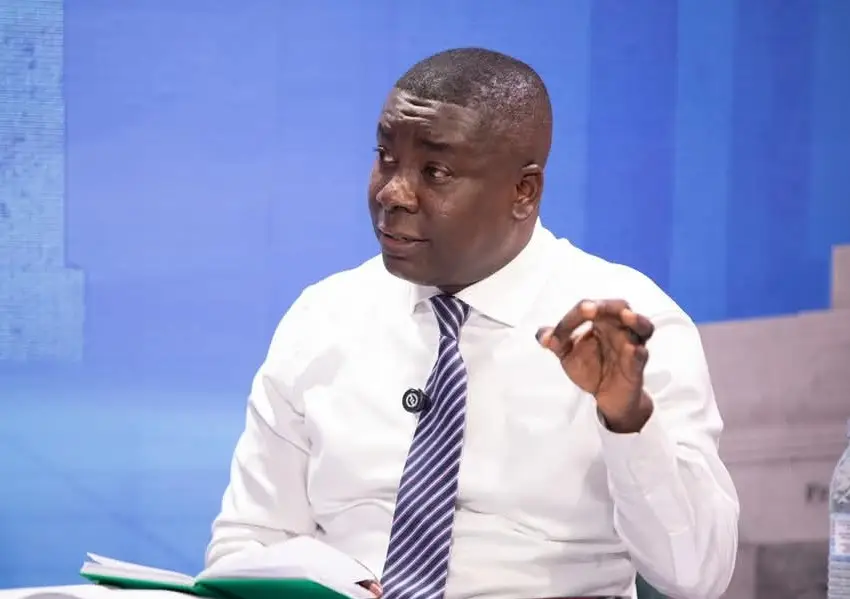
The MP for Tano North, Dr Gideon Boako says the Minority Caucus in Parliament is not celebrating the worsening financial condition of the Bank of Ghana, insisting that its persistent criticism of the central bank’s 2025 financial statements is motivated by concern for the economic future rather than partisan politics.
The Tano North MP and member of Parliament’s Finance Committee made the remarks amid intensifying political debate over the Central bank’s reported GH¢15.6 billion operating loss and the broader controversy surrounding the bank’s deteriorating balance sheet.
Speaking on The Point of View on Channel One TV, Gideon Boako said the Minority’s focus is on protecting the long-term stability of the economy because the central bank remains the country’s last line of financial defence during periods of economic distress.
“We are not gloating over anything, but we all want the best for the country,” he stressed.
“We understand the central bank to be that thick wall that the government or all of us have to fall on once there is trouble in the country, or there are economic mismatches,” he added.
His comments come days after the release of the Bank of Ghana’s 2025 audited financial statements, which triggered fierce exchanges between the governing NDC and the opposition NPP over the true extent of the Bank’s financial losses.
The central bank reported a GH¢15.63 billion operating loss for 2025, up from the GH¢9.49 billion loss recorded in 2024.
The latest results mean the Bank has now recorded losses for four consecutive years, including the massive GH¢60.9 billion loss in 2022 during the height of Ghana’s economic crisis and the Domestic Debt Exchange Programme (DDEP).
The Bank’s financial statements also showed that its negative equity position deepened significantly, moving from about GH¢61.3 billion in 2024 to nearly GH¢93.8 billion in 2025.
The Minority Caucus has since launched a sustained attack on the financial statements, arguing that the actual comprehensive loss was far higher than the headline operating loss being defended by government communicators.
At a press conference addressed by former Information Minister and Ofoase-Ayirebi MP, Kojo Oppong Nkrumah, the Minority claimed the Bank’s total comprehensive loss was closer to GH¢34.9 billion after adding the GH¢19.32 billion recorded under Other Comprehensive Income (OCI).
That claim was later effectively acknowledged by the Bank itself in a detailed explanatory note issued to defend the financial statements.
Amid the controversy, Gideon Boako said the Minority’s concerns revolve around three major issues emerging from the Bank’s accounts.
According to him, the first concern is the worsening negative equity position of the central bank.
“In the financials, three things were crucial, the negative equity position of the bank. Not that it is just critical but because we’ve seen an increase in the negative equity position,” he explained.
He also questioned what he described as signs of policy insolvency at the Bank of Ghana, arguing that although the central bank took steps in the last quarter of 2025 to address liquidity and solvency concerns, the methods used were unconventional.
“There is also what appears to have been an insolvency position with the central bank although there was a smart move in the last quarter of 2025 to kind of get the insolvency resolved but the approach was not the traditional means to get over that,” he stated.
The Minority has consistently argued that the Bank relied heavily on gains from gold sales to improve its solvency position and reduce the apparent scale of its losses.
Boako further questioned the accounting methods used in preparing the financial statements, particularly the decision by the central bank to rely on provisions within the Bank of Ghana Act instead of fully applying International Financial Reporting Standards (IFRS).
“Then there is also the big conversation of the loss…we have to look at the context and magnitude of the loss. Then there is this whole procedure about the accounting procedure that used to prepare this financial statement,” he noted.
He explained that while international accounting standards normally guide the preparation of financial statements, the Bank of Ghana used its own statutory framework in accounting for some of the losses, particularly exchange rate and reserve revaluation losses.
“Relative to what international standards say, the BoG stuck solely to their act to say that their act mandates us to use our own internal accounting methods to prepare our financials,” he argued.
The accounting treatment has become one of the most contentious aspects of the debate after the Bank’s external auditors, KPMG, highlighted in the audited report that the financial statements were prepared using the Bank’s own accounting policies in certain areas permitted under the Bank of Ghana Act.
Despite the criticisms, the Bank of Ghana maintains that it remains “policy solvent” and fully capable of carrying out its monetary policy responsibilities.
The central bank argues that the losses reflect the financial cost of stabilising the economy through aggressive Open Market Operations, reserve accumulation and interventions aimed at reducing inflation and strengthening the cedi.
According to the Bank, those policies helped drive inflation down from 23.8 percent in December 2024 to 5.4 percent by the end of 2025, while the cedi appreciated significantly against the US dollar.
But the opposition insists the financial deterioration of the central bank cannot be ignored, warning that continued losses and deepening negative equity could eventually create broader fiscal risks for the country.

