
Mad rush for KFC’s GH¢15 promotional campaign
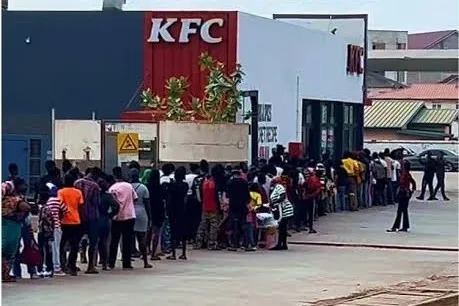
A promotional campaign by KFC Ghana has triggered an extraordinary public response across the country, with large crowds reportedly converging on the fast-food chain’s branches to take advantage of a heavily discounted chicken offer priced at just GH¢15.
The promotion, which attracted particularly intense attention on social media on August 15, 2026, has raised questions about whether KFC adequately anticipated the scale of demand after videos showing huge crowds at some of its outlets went viral.
The most striking scenes occurred at the KFC outlet at the Kwame Nkrumah University of Science and Technology (KNUST), where hundreds of students and residents reportedly gathered outside the restaurant to take advantage of the promotional price.
A video shared by The Ghana Insider on August 15 showed a large crowd surrounding the KNUST branch, with customers forming long queues that spilled into the surrounding areas. The sheer number of people created scenes that were markedly different from the normal operations of the outlet.
The KNUST incident, however, became a symbol of a much wider reaction to the promotion, as KFC branches across the country reportedly experienced significant interest from customers eager to secure the GH¢15 chicken offer.
The attraction appeared to be driven largely by the unusually low promotional price.
For many consumers, KFC is generally viewed as a relatively expensive fast-food option compared with some alternatives available in the Ghanaian market. The reduction of a chicken meal to GH¢15 from GH¢35 therefore created an opportunity for customers who might ordinarily consider the brand beyond their regular food budget.
The promotional offer appears to have changed that equation temporarily.
Students, workers, residents and other consumers were drawn to participating branches, with the KNUST outlet providing the clearest illustration of how quickly demand could rise when the price of a popular food brand is significantly reduced.
At KNUST, the combination of a large student population, residents within the university’s surrounding communities, and the attractive promotional price created what appeared to be an overwhelming turnout.
The response has also shifted attention from the KNUST branch to KFC’s wider network of outlets across the country.
The promotion was not simply a local attraction confined to Kumasi. Reports and social media posts surrounding the offer generated interest from customers in different parts of Ghana, with people seeking to take advantage of the discounted chicken at participating branches.
The scale of the reaction has consequently sparked a broader conversation about promotional planning and customer management across KFC’s branches.
While the available account does not provide a complete branch-by-branch assessment or official figures on customer numbers, the videos circulating online demonstrate the intensity of public interest generated by the offer.
The extraordinary turnout has prompted questions online about whether KFC anticipated the level of demand that a GH¢15 chicken promotion could generate.
Social media users reacting to the footage questioned whether the company had adequately prepared for the number of customers who would respond to the offer.
The situation highlights a familiar challenge for major consumer brands: a promotion designed to attract customers can become difficult to manage when demand substantially exceeds expectations.
At KNUST, the large crowd reportedly stretched beyond the immediate premises of the restaurant, illustrating the operational pressure that can arise when a heavily discounted product attracts hundreds of customers simultaneously.
The reaction also provides an indication of how strongly price influences consumer behaviour in Ghana.
The GH¢15 offer appears to have attracted people who were motivated less by the usual premium associated with the KFC brand and more by the opportunity to obtain the product at a significantly reduced price.
The KNUST turnout therefore became more than just a queue outside a fast-food restaurant. It demonstrated how a significant reduction in price can rapidly transform consumer demand, particularly when the promotion involves a globally recognised brand.
The scenes were further amplified by social media. Video from KNUST quickly attracted attention, while other posts and videos showing people responding to the promotion contributed to the perception of a nationwide KFC rush.
As customers shared images and videos from various locations, the promotion gained additional publicity, potentially encouraging even more people to visit participating outlets.
This created a cycle in which the low price attracted customers, the crowds generated social media content, and the online visibility generated further interest in the promotion.
What was intended as a promotional campaign has consequently developed into a major social media talking point, with the crowds themselves becoming almost as significant as the GH¢15 offer.
The KNUST scenes have particularly captured public attention because of the sheer size of the gathering, but the wider reaction suggests that the promotion resonated with consumers well beyond the university community.

